

We have met Captain Ahab and he is us
Checking in with readers of Moby-Dick--and a bonus podcast by yours truly

How are you enjoying Moby-Dick? Drop a quick response below. Even better, please comment on this essay with your own ideas, quotation from the text, or response to my argument. Let’s keep the conversation going! Beth and I truly want to hear from you.
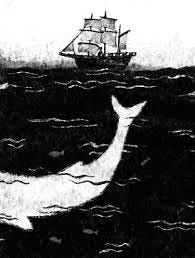
We have met captain Ahab, and he is us.
My high school NFL coach, Wayne Brown, was a superstar, double-diamond coach. (National Forensic League, you silly!) I was on the speech and debate team all four years of high school.
I can’t even begin to unpack the ways that I owe my academic career to this man who challenged me more than any of my classes could. Like all teachers, he had his favorite sayings, things he would trot out when the occasion demanded…or not. One of his was from the 1970 comic strip Pogo: “We have met the enemy and he is us.”
This is a truism that takes years to understand, and some of us never get there. It also happens to be one of Melville’s chief reasons for writing Moby-Dick.
We have known from the beginning that Ahab is the troubled captain of the Pequod, but it takes a while before we meet him in person. When we do, we find a grizzled and fierce old man with a white whalebone peg-leg that he sticks in a crevice on the deck so he can pivot around on it, barking out commands.
Melville also pivots his style to provide more drama. In chapter 36, “The Quarter-Deck” we move from Ishmael’s first-person narration to a dramatic rendering of Ahab’s performance of pinning a doubloon to the mast and challenging his men to find the white whale. Under the chapter title we get stage directions: Enter Ahab: Then, all.
The text is no longer Ishmael’s diary—it is Ahab’s stage. Ahab has a literally captive audience on the ship, and a metaphorically captive audience in all of us. For almost two hundred pages we have been wondering who’s in charge and what’s really going on. Now we know. In the four chapters following this one, Melville seals the deal by offering Shakespearian soliloquy in the voices of Ahab, Stubb, Starbuck, and then a chorus of men. He does this so that we can see that one of these things is not like the others. Ahab has gone over the edge.
In true Shakespearian style, we learn the most about Ahab from what he says and does. Here’s what we learn.
First, we learn that Ahab has a single focus: destroy the whale who maimed him. He answers Starbuck’s question:
“Aye, Starbuck; aye, my hearties all round; it was Moby Dick that dismasted me; Moby Dick that brought me to this dead stump I stand on now. Aye, aye,” he shouted with a terrific, loud, animal sob, like that of a heart-stricken moose; “Aye, aye! it was that accursed white whale that razeed me; made a poor pegging lubber of me for ever and a day!”
Note that it is not Ishmael but Ahab who says that Moby Dick has “dismasted” him—as deliberate symbol as there is in a book all about symbolism. Ahab believes he has lost his manhood along with his leg. He has been bettered by the whale, defeated, publicly shamed, and emasculated. And so he’s out for revenge.
Second, we learn that the whale stands for everything Ahab can’t control. After Ahab’s long rant, it suddenly occurs to an increasingly nervous Starbuck that they aren’t out there to make money from whaling. Starbuck confronts Ahab with his madness.
“Vengeance on a dumb brute!” cried Starbuck, “that simply smote thee from blindest instinct! Madness! To be enraged with a dumb thing, Captain Ahab, seems blasphemous.”
Starbuck is correct. To be enraged with something that cannot speak and did not intentionally attack Ahab is madness. But worse, it is blasphemous. Ahab treats God with contempt, and claims for himself powers (like vengeance) that belong only to God. And here’s where Ahab gives a speech that reveals everything we need to know.
Ahab tells Starbuck to pay attention to the “lower layer.”
“All visible objects, man, are but as pasteboard masks. But in each event—in the living act, the undoubted deed—there, some unknown but still reasoning thing puts forth the mouldings of its features from behind the unreasoning mask. If man will strike, strike through the mask! How can the prisoner reach outside except by thrusting through the wall? To me, the white whale is that wall, shoved near to me. Sometimes I think there’s naught beyond. But ’tis enough. He tasks me; he heaps me; I see in him outrageous strength, with an inscrutable malice sinewing it.”
The “lower layer” is what mindset coaches call “the thing under the thing,” the real issue that’s causing you to act the way you act. The real issue for Ahab is that the whale has become a stand-in everything that he cannot comprehend—control—about creation, God, life itself, and his life. He views himself as a prisoner behind an inscrutable and impenetrable wall. Ahab continues:
“That inscrutable thing is chiefly what I hate; and be the white whale agent, or be the white whale principal, I will wreak that hate upon him. Talk not to me of blasphemy, man; I’d strike the sun if it insulted me. For could the sun do that, then could I do the other; since there is ever a sort of fair play herein, jealousy presiding over all creations. But not my master, man, is even that fair play. Who’s over me? Truth hath no confines.”
“That inscrutable thing is chiefly what I hate.” Ahab despises what he cannot understand. What cannot be comprehended cannot, by definition, be controlled. Ahab wants to be transcendent man; he wants to be important, which he mistakes for being in charge, the big man on the block. He despises the fact that the world is not, nor can it ever be, under his thumb. The fact he cannot control the world insults him.
This is where it gets interesting for us. Melville creates in Ahab the same kind of anti-hero that Mary Shelley creates in Dr. Victor Frankenstein. Ahab and Frankenstein are both products of the enlightenment’s fixation on controlling nature. Frankenstein praises modern scientists who “perform miracles” because they
“…penetrate into the recesses of nature and show how she works in her hiding-places. . . They have acquired new and almost unlimited powers; they can command the thunders of heaven, mimic the earthquake, and even mock the invisible world with its own shadows.”
It doesn’t matter that Ahab is not a scientist. What drives him is the desire to control the natural world, to banish mystery by comprehending it, and to “mock the invisible world with its own shadows.” The Leviathan, we have learned from Ishmael in the preceding pages, both is and stands for that invisible world, the power under the surface of what can be measured by science. That power is mystery. Metaphysics. Quantum reality. History. The working of culture and the arts. The whale—Leviathan—stands for all of it. Leviathan as uncontrollable mystery is why Jonah is swallowed by a mysterious fish. Leviathan as uncontrollable mystery is why God’s answer to the biblical Job includes it. Job chapter 38:
Then the Lord answered Job out of the whirlwind:
“Who is this that darkens counsel by words without knowledge?
Gird up your loins like a man;
I will question you, and you shall declare to me.“Where were you when I laid the foundation of the earth?
Tell me, if you have understanding.
Who determined its measurements—surely you know!
God continues, Job chapter 42:
“Can you draw out Leviathan with a fishhook
or press down its tongue with a cord?
Can you put a rope in its nose
or pierce its jaw with a hook?
Will it make many supplications to you?
Will it speak soft words to you?
Will it make a covenant with you
to be taken as your servant forever?”
Reader, please don’t miss this! This is not Melville being a “little influenced” by the Bible. God’s response to Job is the point of Moby-Dick. Ahab cannot control the world because Ahab is not God.
You aren’t like Ahab, you say? Good for you. But Melville doesn’t let any of us off the hook here (as it were). He wants us to see that all modern persons have a little Ahab in them: a small and fearful soul that lashes out with acts of impotent aggression. When that little Ahab in a leader is not prophetically shut down but is instead given a big stage (and a powerful military), there can only be one outcome: destruction culminating in self-destruction.
We have met the enemy and he is us.
Yes of course I’m talking about Trump. But hear me well: Trump is just an extreme example of how unhinged we can all become if we fail to recognize, and tame, our desire to rule the world and control for all contingencies. We’ve all got to lift our own ugly rocks, to see the creepy-crawlies underneath. What is the lower layer, the thing under the thing?
I believe it is fear. Here’s how I think it operates on us today.1
1. The world is a mystery that we can understand but never comprehend or control.
The word Logos referred to in John chapter 1—the Word that becomes flesh—means, among other things, that ultimate reality is intelligible. We can say true things about it, which also means we can say false things about it. But humans can never comprehend that reality, a word that carries with it the idea of full, encompassing control of it. Nevertheless, to comprehend and thus control reality has been our goal since the enlightenment. Romantic, modern, late modern, or postmodern: we all want to control reality, to eliminate contingency, to live life on our own terms. It’s a decidedly aggressive stance. We are all Ahab.2
Here’s the sociologist Hartmut Rosa on the subject, in his powerful little book The Uncontrollability of the World. Note how this aggressive stance has now been hidden in our unconscious. (I added the bold below):
We learn and become habituated to a certain practical attitude toward the world that goes far beyond our cognitive “worldview,” our conscious assumptions and convictions about what exists in the world and what the world is all about, what it all comes down to. The first guiding thesis that I would like to develop in this essay is that, for late modern human beings, the world has simply become a point of aggression. Everything that appears to us must be known, mastered, conquered, made useful. Expressed abstractly, this sounds banal at first—but it isn’t. Lurking behind this idea is a creeping reorganization of our relationship to the world that stretches far back historically, culturally, economically, and institutionally but in the twenty-first century has become newly radicalized, not least as a result of the technological possibilities unleashed by digitalization and by the demands for optimization and growth produced by financial market capitalism and unbridled competition.
Ahab sees the world as a point of aggression. Rosa wants you to understand that the twenty-first century has merely intensified and concealed (somewhat) this “me vs. everything else” view of the world, of “what it all comes down to.” What it has come down to is a battle that we imagine that we are fighting and that we imagine we are also losing. Feeling thus beleaguered, besieged, and beaten down seems to me to be our prevailing social imaginary in 2026.
2. What we cannot understand or control, we fear. What we fear, we demonize in order to destroy (ultimate control).
Global culture makes us feel more out of control than ever before. Feeling out of control both comes from fear and leads to more fear. Fear breeds sin. Greed is fear of not having enough. Covetousness and envy is fear that we are not enough. We are always trying to control our experience in the world because ultimately we are afraid of what we know is unchangeable: that we are all destined for death.3
This is basic human nature, but we do not pay nearly enough attention to its force. Because we can’t control other people, we try to manipulate those in our orbit. If the others we fear are so different from us that we can’t understand them (inscrutable), we seek safety in our tribe. Our tribe will always affirm agreed-upon fears: “yes, those people are animals who are clearly out to get us! We are right to. . . keep them out of country / deny them civil rights / bomb them back into the Stone Age.”
Please hear me when I’m saying that everyone does this. No tribe is immune. Still, some people have learned to stop themselves and ask questions before they get to Ahab-level monomaniacal behavior. It is not easy to back down from such deliberation, but it is possible. It takes courage, wisdom, and humility. It takes self-sacrificial love that must be learned.
3. Trying to destroy what we cannot control ultimately destroys us.
The truly wicked part of this is that our desire to control destroys a lot of other people first. Then it destroys us.
But I am getting ahead of myself. Stay tuned: together we will watch this drama unfold on the Pequod.
For now suffice it to say that many great writers have been trying to teach us this lesson. I am genuinely mystified by how hard it is for us to learn it. What will it take? If you have any ideas, please let me know!
Bonus! Last fall I had a conversation with Nadya Williams at Mere Orthodoxy’s podcast Christians Reading Classics. She has also written a book by that name: Christians Reading Classics: An Introduction to Greco-Roman Classics from Homer to Boethius.
Nadya asked me which classic of American lit I would be willing to talk about, and I said Moby-Dick (this was well before Beth Felker Jones and I began our slow read together).
The episode just came out this month and you can listen to it here, or anywhere you get your podcasts.
I’m consistent with myself (aka redundant), and in the podcast I emphasize that the healthy spiritual life is not about taking mastery over the world, but learning how to receive and share all the good gifts from our Father.
***
In Read with Me! for Eastertide we are reading Niall Williams, This is Happiness. Come join us!
Hartmut Rosa is one of my guides.
I wrote a book about how the biotechnological revolution is a Gnostic effort to control for all physical contingencies—especially the inevitability of death. You can purchase that here.
Note that Ahab is chiefly afraid that behind the wall of inscrutability there will be nothing at all. If there’s nothing at all there then, by golly, he’s going to be in charge of that nothing until he dies.